

Showing posts with label sorting. Show all posts
Showing posts with label sorting. Show all posts
Monday, September 3, 2012
Math Games with Animal Counters

Wednesday, March 21, 2012
Shape Sorting Game

Monday, March 5, 2012
Fun with... Laundry!

First we sorted the clothes into categories, and then I showed the girls how to fold different types of items:


E didn't want to play the sock game at all because she was sitting in Baby H's carseat pretending to be a baby. It brought tears to my eyes to see what a big girl she looks like in the chair that we used to bring her home from the hospital as a 4-lbs preemie only 2.5 years ago. How quickly they grow!
The good time we had with laundry reminded me that kids' activities don't always have to be complicated or pre-planned... there is fun (and learning) in even the simple everyday things.
Oh, and I'd love to say this activity helped me get something done around the house. But, alas, after the clothes were folded, the kids decided it would be fun to throw them back into the laundry basket and then engage in other miscellaneous mess-creating activities around my bedroom...
Monday, February 20, 2012
Organizing Objects into Categories
L and E are almost 31 months old. This week we started going through the lessons in the K-2 curriculum Building Foundations of Scientific Understanding by Bernard Nebel (BFSU for short). We started with lesson A/B-1, which is the concept of organizing things into categories. Sorting is an activity I've been doing with the girls for a long time (sorting various items by shape and color, cleaning up room and putting toys in specific locations by type, etc..). So I wanted to reinforce the concepts they already know about grouping objects by attributes, introduce the terminology "organization" and "category", and also challenge them to think about different ways that the same objects can be organized.
We have a collection of foam magnets representing different objects. I decided to use these magnet representations of objects rather than the actual objects because I think it adds a bit of additional difficulty since the girls have to think about the properties of the real object (for example, in real life a feather is soft, but the magnet representation is not).
The way we played this game, is I would put a collection of approximately 10 magnets at a time on a cookie sheet and then ask the girls if they see some objects that have things in common that we could use to categorize them. Sometimes the girls had good suggestions (like organizing based on whether an object was an animal or not, or whether it was a toy, or by color), and other times I came up with the category to give them ideas of the different ways we can look at these objects. Once we decided on categories, the girls picked out the objects that fit into each category and transferred them to the smaller magnetic boards. Here are some of the ideas that we came up with:

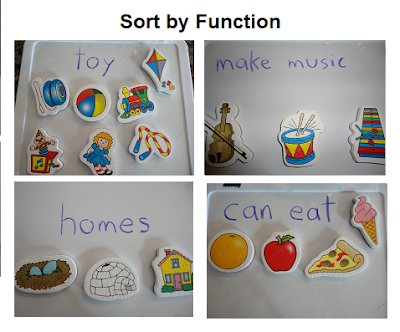
 It would be really easy to use clipart, photos, or web images to create flashcards to serve the same purpose as these magnets. I have an open request to my husband to get me a large oil drip pan the next time he is at the hardware store, which we can use as a giant magnet board (I've seen the idea all over Pinterest). Once we have that larger magnet board, I want to repeat the idea and create some Venn diagrams, so the girls can see that the same object can exist in multiple categories (a chicken is a bird, but also lives on the farm, etc..).
L and E really liked the categorization activity and we played a long time. We also played a memory game where I put some objects on the cookie sheet and then turned it around and asked the girls to recall the objects. L has amazing (almost photographic) memory. I did show them that it is even easier to remember the objects if they put them into categories in their mind and then recall them based on the categories. They did really well if I reviewed the categories and objects with them, but didn't quite grasp the concept of employing that technique in their head on their own (which is fine - they are only 2.5 years old, after all).
I peeked ahead at the lessons we'll be doing later on in the BFSU curriculum, and I think the girls are going to love the categorizing in future activities (solid/liquid/gas, living/nonliving, animal classifications, etc..).
We have a collection of foam magnets representing different objects. I decided to use these magnet representations of objects rather than the actual objects because I think it adds a bit of additional difficulty since the girls have to think about the properties of the real object (for example, in real life a feather is soft, but the magnet representation is not).
The way we played this game, is I would put a collection of approximately 10 magnets at a time on a cookie sheet and then ask the girls if they see some objects that have things in common that we could use to categorize them. Sometimes the girls had good suggestions (like organizing based on whether an object was an animal or not, or whether it was a toy, or by color), and other times I came up with the category to give them ideas of the different ways we can look at these objects. Once we decided on categories, the girls picked out the objects that fit into each category and transferred them to the smaller magnetic boards. Here are some of the ideas that we came up with:


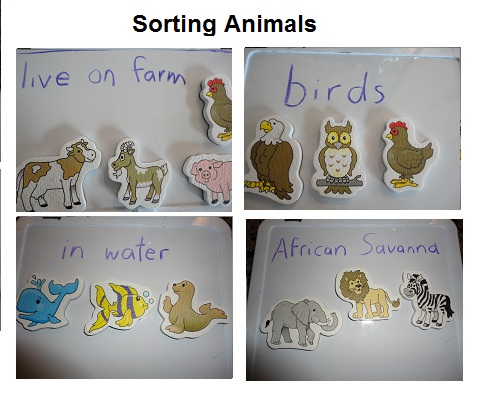
L and E really liked the categorization activity and we played a long time. We also played a memory game where I put some objects on the cookie sheet and then turned it around and asked the girls to recall the objects. L has amazing (almost photographic) memory. I did show them that it is even easier to remember the objects if they put them into categories in their mind and then recall them based on the categories. They did really well if I reviewed the categories and objects with them, but didn't quite grasp the concept of employing that technique in their head on their own (which is fine - they are only 2.5 years old, after all).
I peeked ahead at the lessons we'll be doing later on in the BFSU curriculum, and I think the girls are going to love the categorizing in future activities (solid/liquid/gas, living/nonliving, animal classifications, etc..).
Sunday, February 19, 2012
Early Learning - Fun with Feathers
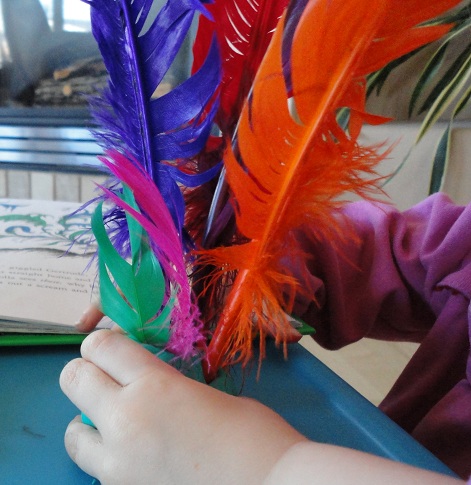
L and E are almost 31 months old. Our Tot School theme today was "feathers". I tried to incorporate a variety of activities that involved sensorial exploration, art, math, science, literature, physical play, and lots of fun.
 We've done a lot of free-play with feathers already, so I focused more on the guided activities. First we read the short story, Gertrude McFuzz by Doctor Seuss (it's in the Yertle the Turtle collection). It's a great story about a bird who is not happy that she has only one feather in her tail and her friend has two, so she finds a way to grow more and more feathers and has to pay the consequences (fantastic lesson on jealousy).
 I gave the girls some playdough and googly eyes for making birds, as well as some berries. First their birds started out with one feather each, and then as we read the story and Gertrude ate the berries and grew more feathers, the girls added feathers to their birds (and then removed them as the feathers were plucked off).


The girls requested that we repeat the story/activity a couple times. E loved her baby bird so much that she carried it around with her for the duration of our playtime:

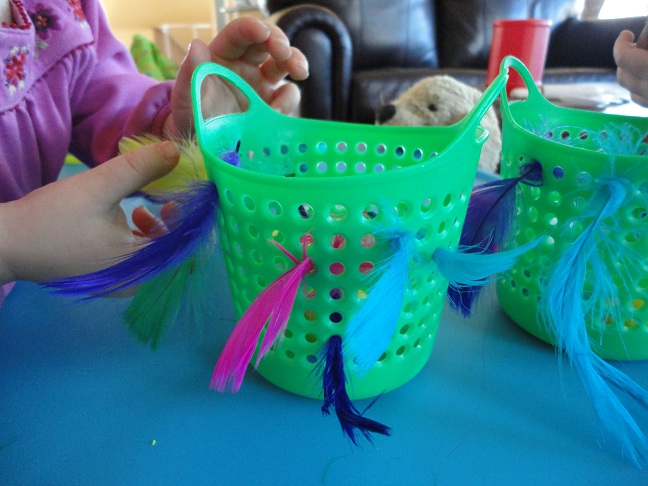
We made nests for our birds out of some small baskets (3 for $1 at Target). And inserted feathers through the holes in the basket to decorate the nests (awesome fine-motor activity). Of course, no nest would be complete without some eggs:


Next we experimented with more properties of feathers and air resistance. I challenged them to guess which will fall to the ground first, a ball or a feather:

Then the girls practiced both dropping and catching feathers with their hands as well as various containers. Since the feathers fall fairly slowly, this was a wonderful exercise in hand-eye-coordination and catching skills.


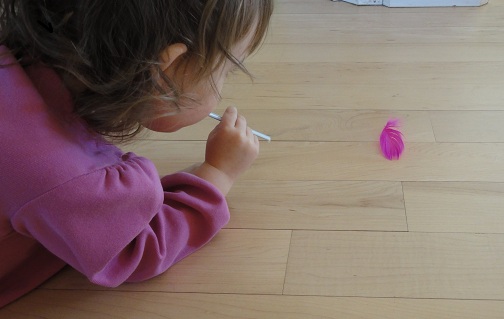
Then I showed the girls how to blow on their feathers through a straw, and we had races blowing our feathers all through the house:

To make cleaning up more fun, we sorted the feathers by color:

Then I posed the question: what will weight more, a bowl of feathers or a bowl of blocks? Although the girls both knew the right answer, we wanted to test out our theory by giving it a try:

 I took out the bucket scale, and we figured out that the blocks do indeed weigh more than the same volume of feathers, and that our bowl of feathers weighed 4 blocks (or 4 grams). From that, we explored the unit blocks, played with the scale and did other non-feather-related activities. I could think of many more things we could do with feathers (math games, patterning, etc..), but the time felt right to just let the girls explore on their own.


The girls requested that we repeat the story/activity a couple times. E loved her baby bird so much that she carried it around with her for the duration of our playtime:

We made nests for our birds out of some small baskets (3 for $1 at Target). And inserted feathers through the holes in the basket to decorate the nests (awesome fine-motor activity). Of course, no nest would be complete without some eggs:

Next we experimented with more properties of feathers and air resistance. I challenged them to guess which will fall to the ground first, a ball or a feather:

Then the girls practiced both dropping and catching feathers with their hands as well as various containers. Since the feathers fall fairly slowly, this was a wonderful exercise in hand-eye-coordination and catching skills.


Then I showed the girls how to blow on their feathers through a straw, and we had races blowing our feathers all through the house:
To make cleaning up more fun, we sorted the feathers by color:

Then I posed the question: what will weight more, a bowl of feathers or a bowl of blocks? Although the girls both knew the right answer, we wanted to test out our theory by giving it a try:


Monday, February 13, 2012
Playing with Coins
L and E are 30 months old.
I let the girls play with real coins this past weekend. I could tell they enjoyed the heavier feel of the metal coins instead of their plastic play money. First I gave them a mixture of water, lemon juice, and salt to wash the coins in, along with some cotton balls and paper towels for polishing them. They didn't turn out as shiny as I expected (I think vinegar/salt is supposed to create a chemical reaction in copper pennies that will get them shiny), but it did get a layer of grime off. The coin washing activity (like anything water-related) kept the girls occupied for quite a while.
After the coins got their baths, we explored some of the properties of coins. I asked the girls to sort them, but they had a lot of trouble telling the difference between the various silver-colored coins:

So we compared their sizes to see the differences:


Friday, February 10, 2012
Military Play

Who says girls can't play with toy soldiers? I found a cheap plastic military figure set at Target for $1.50 (from the toys they couldn't sell at Christmas). There are lots of opportunities for sorting and grouping the soldiers and vehicles by color, size, type, etc.... We use the fences to make different shapes. The wheels come off all the trucks and planes, so it's a good fine motor activity to take them off and put them back on again. It's pretty obvious that they're girls, though - they're very delicate with the soldiers and like to take the tops off the trucks to make beds and baths for them.
Tuesday, February 7, 2012
Homemade Math Manipulatives - Sorting Hearts

Here are some homemade math manipulatives I created for L and E (30 months old).
I've decided to use the RightStart Math curriculum for the girls. It is based on hands-on learning using lots of math manipulatives (and an abacus, too!). I'm really excited about this curriculum, but I'll talk more about that in another post. Level A is supposed to be for Kindergarteners, but we've already done the first 3 lessons and the girls are really enjoying it and are grasping the concepts just fine. A big part of the curriculum is to condition the brain to identify groups of objects instead of always count them. I wanted to create some of my own manipulatives to help reinforce grouping and sorting concepts.
These little hearts are made from Crayola Model Magic. It's an air-dry 'clay' that has the feel of foam when it is dry (and doesn't break if dropped). We used the same technique to make Christmas ornaments a couple months ago. I rolled the modeling compound out with a rolling pin and punched out shapes with a cookie cutter. Then I pressed different numbers of 'gems' into each one:


The girls didn't help me with this project, but they had a good time making their own creations out of the modeling material:

Back to the Math Hearts. There's no correct way to play this 'game', but here are a couple things we did. First I'd show them one heart and ask them how many jewels it has (without counting). The girls are really good at identifying groups of 1-3, but still working on groups of 4 and 5 (with the RightStart Math program, everything is based on 5s and 10s, which is how Asians are taught to do math, so once we can identify groups up to 5, we can do all types of operations fairly quickly). Then I put all the hearts down on the table and we sorted them in different ways - by heart color, by gem color, by gem shape, and by the number of gems. After sorting them into groups I asked questions about which group had the most and least, how many are left if we take one away, etc.. In future play, we'll do some ordering and sequencing activities with these manipulative as well. They are so versatile! I have a feeling that the girls (especially E) will want to pretend they are cookies as well and feed them to their stuffed animals - which is fun too!

Subscribe to:
Posts (Atom)