L and E are 31 months old. I always like combining physical activity with learning (like jumping over sight words, making an obstacle course in our living room, etc..), and I've had the idea of integrating math skills with Olympic-style activities for quite some time.
So yesterday after I completed my own record-setting endurance event (a 2-hour nap with Baby H!), the twins and I had a little bit of Olympic fun. It almost turned into a reenactment of the first Greek Olympics (in the nude!), but I managed to keep the girls dressed long enough to take some pictures.
Our first event was the long jump:
This was the first time the girls had used a tape measure. They helped me read the numbers, and we used ordinal/math words: "L's first jump was 10 inches, and her third jump was 22 inches. This was her longest jump", etc.. (and yes, my 31 month old can jump almost 2 feet!).
We followed this with the high jump. We've jumped over the broom before, but this time we added some number concepts to the game by increasing the height by one Duplo block at a time. The girls counted the blocks and made sure we had the same number on each side. Then we sang a variation of Barney the Dinosaur's "Number Limbo" song (substituting "limbo" with "high jump", "under" with "over", etc..).
A little more bragging - the girls both jumped over a height of 4 duplo blocks! When we got to 5, they decided it would be easier to go under, which was a fun challenge too.
Next it was time for some track & field running events. The girls took turns running around the living room, while the other one operated the timer:
We practiced hitting the correct buttons for Stop and Go, read the numbers on the display, and counted the laps. I was most impressed by how the twins took turns very nicely with the highly-coveted stopwatch.
The shotput (beanbag) throw provided more number practice:
The girls read the digits with ease (the only ones they mix up are 6 and 9), and were able to tell me which numbers were greater.
The most creative event I came up with was Weight Lifting. I put out 24 blocks and asked the girls to put 12 in each pail. Then we weighed them to see if they were the same:
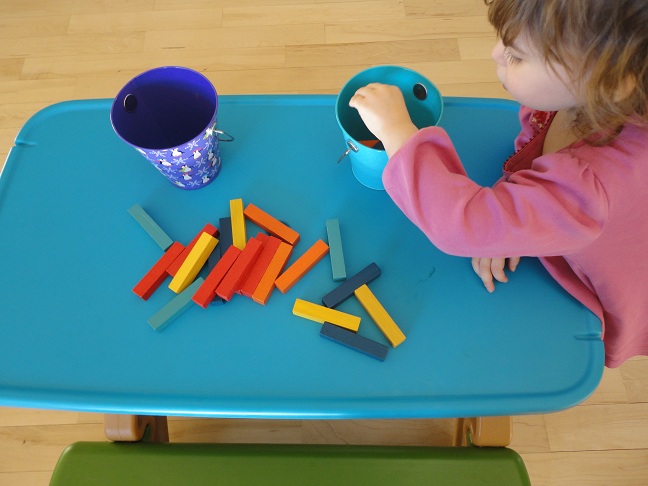
After getting both sides to weigh the same, I taped the buckets to the broomstick and the girls did some weight lifting:
Their Dad had taught them to grunt and huff-and-puff while they lift weights (for extra drama), so it was hilarious!
Our Olympic afternoon ended with some rythmic gymnastics:
We had so much fun. I'm planning on building on this and doing an entire Olympic week this summer for the 2012 Summer Olympics!
Showing posts with label scale. Show all posts
Sunday, February 26, 2012
Sunday, February 19, 2012
Early Learning - Fun with Feathers
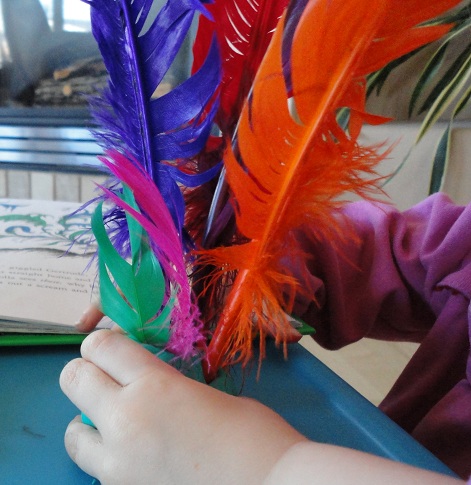
L and E are almost 31 months old. Our Tot School theme today was "feathers". I tried to incorporate a variety of activities that involved sensorial exploration, art, math, science, literature, physical play, and lots of fun.
We've done a lot of free-play with feathers already, so I focused more on the guided activities. First we read the short story, Gertrude McFuzz by Doctor Seuss (it's in the Yertle the Turtle collection). It's a great story about a bird who is not happy that she has only one feather in her tail and her friend has two, so she finds a way to grow more and more feathers and has to pay the consequences (fantastic lesson on jealousy).
I gave the girls some playdough and googly eyes for making birds, as well as some berries. First their birds started out with one feather each, and then as we read the story and Gertrude ate the berries and grew more feathers, the girls added feathers to their birds (and then removed them as the feathers were plucked off).
The girls requested that we repeat the story/activity a couple times. E loved her baby bird so much that she carried it around with her for the duration of our playtime:
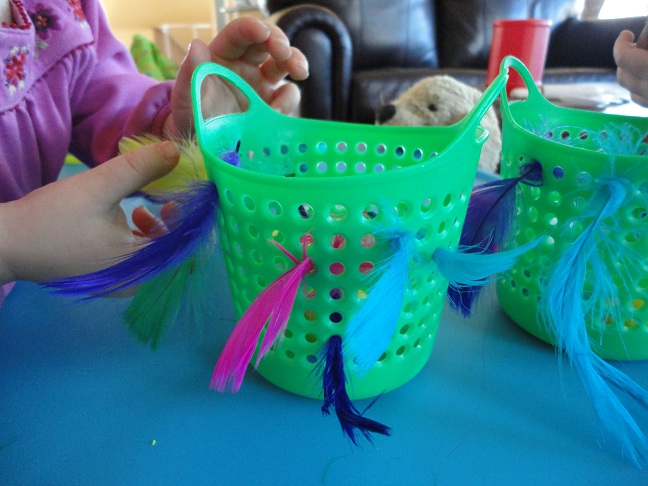
We made nests for our birds out of some small baskets (3 for $1 at Target). And inserted feathers through the holes in the basket to decorate the nests (awesome fine-motor activity). Of course, no nest would be complete without some eggs:
Next we experimented with more properties of feathers and air resistance. I challenged them to guess which will fall to the ground first, a ball or a feather:
Then the girls practiced both dropping and catching feathers with their hands as well as various containers. Since the feathers fall fairly slowly, this was a wonderful exercise in hand-eye-coordination and catching skills.
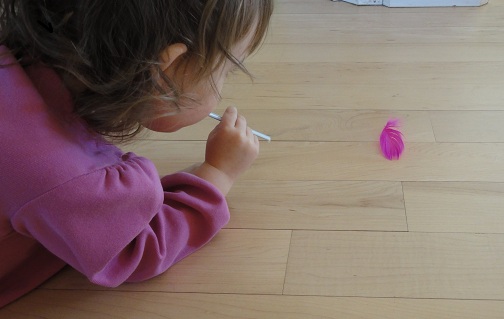
Then I showed the girls how to blow on their feathers through a straw, and we had races blowing our feathers all through the house:
To make cleaning up more fun, we sorted the feathers by color:
Then I posed the question: what will weight more, a bowl of feathers or a bowl of blocks? Although the girls both knew the right answer, we wanted to test out our theory by giving it a try:
I took out the bucket scale, and we figured out that the blocks do indeed weigh more than the same volume of feathers, and that our bowl of feathers weighed 4 blocks (or 4 grams). From that, we explored the unit blocks, played with the scale and did other non-feather-related activities. I could think of many more things we could do with feathers (math games, patterning, etc..), but the time felt right to just let the girls explore on their own.
We've done a lot of free-play with feathers already, so I focused more on the guided activities. First we read the short story, Gertrude McFuzz by Doctor Seuss (it's in the Yertle the Turtle collection). It's a great story about a bird who is not happy that she has only one feather in her tail and her friend has two, so she finds a way to grow more and more feathers and has to pay the consequences (fantastic lesson on jealousy).
I gave the girls some playdough and googly eyes for making birds, as well as some berries. First their birds started out with one feather each, and then as we read the story and Gertrude ate the berries and grew more feathers, the girls added feathers to their birds (and then removed them as the feathers were plucked off).
The girls requested that we repeat the story/activity a couple times. E loved her baby bird so much that she carried it around with her for the duration of our playtime:
We made nests for our birds out of some small baskets (3 for $1 at Target). And inserted feathers through the holes in the basket to decorate the nests (awesome fine-motor activity). Of course, no nest would be complete without some eggs:
Next we experimented with more properties of feathers and air resistance. I challenged them to guess which will fall to the ground first, a ball or a feather:
Then the girls practiced both dropping and catching feathers with their hands as well as various containers. Since the feathers fall fairly slowly, this was a wonderful exercise in hand-eye-coordination and catching skills.
Then I showed the girls how to blow on their feathers through a straw, and we had races blowing our feathers all through the house:
To make cleaning up more fun, we sorted the feathers by color:
Then I posed the question: what will weight more, a bowl of feathers or a bowl of blocks? Although the girls both knew the right answer, we wanted to test out our theory by giving it a try:
I took out the bucket scale, and we figured out that the blocks do indeed weigh more than the same volume of feathers, and that our bowl of feathers weighed 4 blocks (or 4 grams). From that, we explored the unit blocks, played with the scale and did other non-feather-related activities. I could think of many more things we could do with feathers (math games, patterning, etc..), but the time felt right to just let the girls explore on their own.
Sunday, February 5, 2012
Blocks in Socks - Early Math Game
L and E are 30 months old.
Yesterday we tried an activity called "Blocks in Socks". It was loosely inspired by an idea in this book, with a lot of my own variations:
First I put one, two, or three 1-cm unit blocks in a (clean) sock, and invited the girls to reach in the tell me how many blocks were in the sock. They had fun guessing and subsequently pulling the blocks out to count them, but didn't get this one right. I love that this was challenging for them and we can redo this activity later.
Then I filled four socks with different amount of blocks (I wanted there to be big differences so it was something like 5, 10, 20, and 30 blocks). Then I asked the girls if they could feel the outside of the sock to determine which one had the most blocks and which had the least. Then we lifted them out to see which was heaviest and which was lightest. They really understood this concept well.
To check our answers, we emptied the contents of the socks into oversized test tubes, and discussed the differences between the amounts and how we can use visual discrimination to compare amounts instead of counting.
There were a lot of skills involved in this process including screwing the test tube lids on and off (L has been doing this for a while, but E is finally figuring it out), and figuring out how to transfer blocks from the socks into the test tubes without spilling them on the floor. We also shook the test tubes and listened to the sound they made. I got out the scale and we weighed the groups of blocks. They understood the concept that the heavier side will be lower. Then I let them play with the scale all on their own, and they had fun putting various objects in each side. E really enjoyed putting objects in the little drawer too.
I'll definitely revisit this activity a couple more times as they get older, but overall it provided over an hour's worth of fun exploration, making it a success.
Subscribe to:
Posts (Atom)